
02.03.2026
From February 25 to 27, 2026, the 22nd Conference on Applied Automation Technology in Education and Development (AALE) took place at TH Rosenheim. Under the guiding theme “Mechatronic systems for automation: progress through precision and flexibility”, experts from industry and academia discussed how industrial value creation processes can be designed to be more efficient, flexible and competitive in the future.
The conference focused on established and new methods to increase the precision of automation systems, enhance their flexibility and shorten development cycles – all of which are key factors for maintaining the competitiveness of Germany as an industrial location.
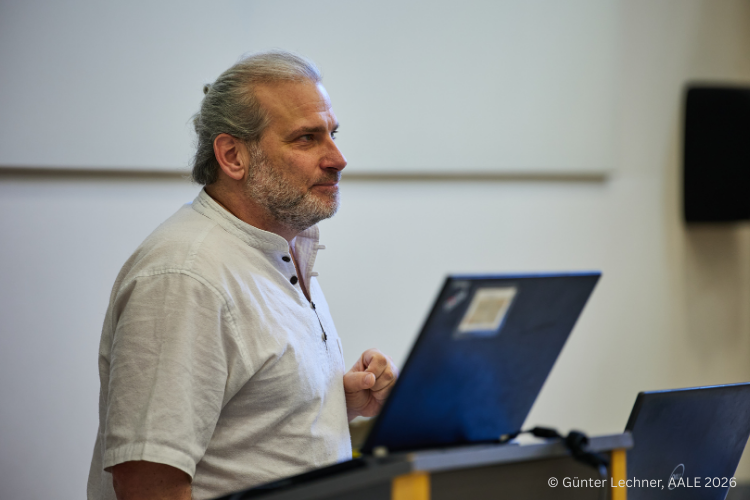
A key highlight of the conference was the keynote by Michael Grampp, Head of Development of the Business Unit Automation at esmo AG. In his presentation “Nothing is as hard as software. How a generic, modular and configurable standard can change company culture”, he combined his personal professional journey with fundamental questions of modern software development in mechanical engineering.
The starting point of his keynote was a seemingly simple yet essential question:
What is software development really about?
Grampp described software not as an abstract construct, but as the interaction of many small components with different tasks – shaped by experience, practical relevance and a deep understanding of the needs of all stakeholders involved.
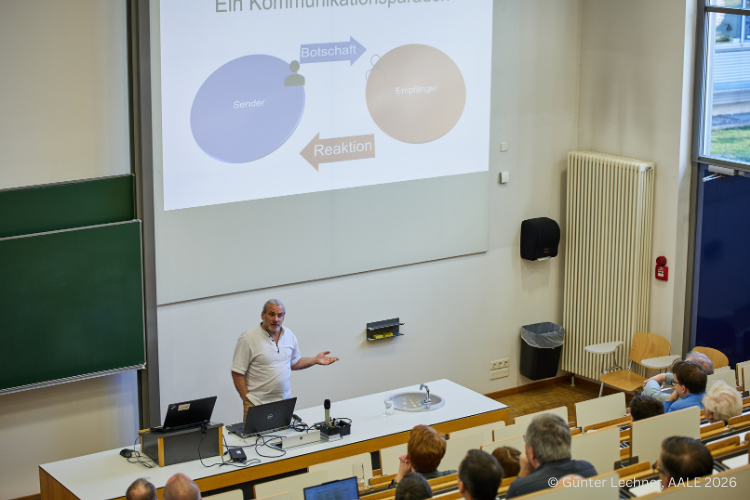
A central theme of the keynote addressed the classic barriers of understanding in projects:
truth, perception and reality.
The key insight: everyone is partly wrong – and at the same time partly right. The solution does not lie in technical extremes, but somewhere in between. Only when people truly understand each other can the right technology be developed.
From this, Grampp derived crucial questions:
What does my counterpart really want?
What is the true underlying process?
Which parts of it can be meaningfully automated – and at what cost?
According to Grampp, these answers must be continuously questioned, as processes, requirements and conditions are constantly evolving.
Grampp explained why software plays a unique role in mechanical engineering. Software does not physically “break,” is never completely error-free, always represents only a part of reality and remains invisible to many users. For this reason, it is often perceived as the root cause of problems – even when the actual causes lie in communication or process understanding.
Although software should be logical, it often does not appear that way when original assumptions, intentions or requirements are lost over the course of a project. These insights form the basis of the approach esmo automation has been consistently pursuing for several years.
Based on these principles, esmo automation has developed esmo CORE, a machine control system with a fully graphical user interface. The Human Machine Interface (HMI) consistently avoids code modifications during commissioning and operation.
All settings are configured via the frontend, supported by clearly defined roles and permission concepts. Commissioning engineers can configure everything required for machine operation without accessing the code, while software developers focus on stable, modular and scalable architectures.
The overarching goal is clear:
Everyone should be able to focus on what they do best.
This clear separation of responsibilities not only changes technical workflows, but also improves communication between design engineering, software development, commissioning, service and customers. And changing communication ultimately leads to a long-term transformation of company culture.
The positive effects are already evident today – in machines equipped with esmo CORE that are operating in the field, as well as in new projects where these principles are applied from the very beginning. Engineering, coordination and collaboration are being fundamentally rethought.